
By Josephine Ting | Josephine Ting Strategy & Management
There’s a reason Instagram’s CEO is signaling a shift toward raw, less polished content in 2026: people are tired of content that looks perfect but feels empty. In health and wellness, that matters even more, because your audience is not just deciding whether they like your content. They’re deciding whether they can trust you with their health.
For holistic health practitioners, AI-generated content carries a specific additional risk. It can make your brand faster to produce, but slower to trust. And in this industry, trust is the thing that converts a viewer into a patient.
1 — The Reality: Polished Is Cheap Now
Let’s talk about this honestly. Generative AI made polished content cheap and abundant, which means it stopped being a differentiator and started being noise. The moment everyone can produce the same clean caption, the same generic carousel, or the same overly smooth image, the market becomes flooded with sameness.
That is exactly why raw, human content is rising in value. A 2026 social trend roundup referencing Instagram CEO Adam Mosseri says the platform is moving toward “raw, real human content” because AI-flooded feeds have made too-perfect content feel less believable. That shift matters for practitioners because your audience is not looking for another polished brand voice. They are looking for a person who can think clearly, explain clearly, and stay human.instagram+1
Health and wellness audiences are especially sensitive to this. According to IDHL’s 2026 Health and Beauty Consumer Research, 70% of UK adults said they were concerned about trusting AI-generated images, while 23% of health browsers now use generative AI to discover products and services. That’s the tension right there: people may use AI to search, but they still want a human when it comes time to choose.
If your content looks synthetic, your audience may assume your care is synthetic too. That is a problem.
2 — What the Data Actually Says
Human-aware personalization beats generic automation
Healthline Media’s 2026 health marketing research says the next era of health marketing will be shaped by human-aware personalization, not just data-driven targeting. Their research notes that consumers are no longer impressed by messages that merely “know” them. They expect content that reflects their intent, emotional context, and stage in their health journey.
That’s a big deal for practitioners. It means a caption written by AI can be technically correct and still miss the thing that makes someone feel seen. In health, being seen is not optional. It is part of the trust process.
Healthline Media also says that personalization in health is no longer a novelty — it’s a responsibility. That is the part most marketers miss. Personalization is not about sounding clever. It’s about helping a person make a hard decision with less confusion and more confidence.
AI is useful behind the scenes, risky in the foreground
There is an important distinction here: AI as a backend tool versus AI as the public face of your brand.
AI is useful for:
- Drafting a rough starting point.
- Helping you organize ideas.
- Supporting scheduling, admin, and research.
- Speeding up repetitive work.
AI is risky when it becomes:
- AI-generated images with no human oversight.
- AI-written captions that do not sound like you.
- Content that removes the emotional texture of your work.
- A brand voice that feels generic, flattened, or distant.
In other words, AI can support your work. It should not replace your voice.
Trust is a conversion issue, not an aesthetic issue
IDHL’s 2026 research also shows that consumers are overwhelmed by choice overload in wellness. When people are overwhelmed, they do not choose the most polished option. They choose the option that feels safest, clearest, and most human.
That means your content has one job before anything else: reduce uncertainty.
If AI content strips out your lived perspective, your clinical judgment, or your warmth, it is not helping conversion. It is weakening it.
3 — Industry-Specific Nuance: Why Holistic Health Is More Vulnerable
Acute Health Practitioners
For acute practitioners — pain, sleep, digestion, hormones — the AI trust gap is especially dangerous. These patients are often arriving after something else did not work. They are skeptical for a reason.
They are not just looking for information. They are looking for discernment. If your content sounds mass-produced, they may assume your care is too.
What works here:
- Clear explanations of your approach.
- Real examples from practice, without violating privacy.
- Short, direct videos where your face and voice are present.
- Language that sounds like a practitioner, not a template.
Long-Term Wellness Practitioners
For prevention, nervous system work, and lifestyle change, trust grows slowly. That means your content has to feel steady, grounded, and lived in.
These clients are not buying a quick fix. They are buying consistency, safety, and the feeling that you understand how hard change actually is. AI-forward content often misses that nuance because it tends to flatten emotional context.
What works here:
- Stories about the slower parts of change.
- Educational posts that sound like real teaching, not scripted teaching.
- Content that reflects patience, not urgency theater.
- A visible human presence across feed, Stories, and DMs.
Coaching Practitioners
Coaching clients are usually buying transformation that involves identity, behavior, and trust over time. That means the relationship matters as much as the method.
AI content can make coaching look easy, neat, and overly packaged. That is the wrong signal. Real coaching is often messy, relational, and deeply personal.
What works here:
- Voice notes, video, and text that sound like you.
- Reflections on what you notice in real client work.
- Posts that name the emotional reality of change.
- Language that makes people feel understood, not managed.
4 — Strategic Implications: What to Actually Do Tomorrow
Here’s the part nobody told you: you do not need to abandon AI. You need to use it in the right layer of the work.
Use AI behind the scenes
AI can help you:
- Brainstorm content ideas.
- Turn notes into first drafts.
- Organize your weekly themes.
- Draft admin emails or scheduling reminders.
- Summarize research before you write.
That saves time. And for a time-poor practitioner, saving time matters.
Keep humans in the foreground
Your public content should still sound like a practitioner, not a machine. That means:
- Write from real observations.
- Use your own phrasing.
- Include clinical nuance.
- Share your actual perspective, not generic wellness language.
If a post could belong to any practitioner, it probably does not belong to you.
Audit your content for trust signals
Ask yourself:
- Does this sound like me?
- Does this reflect how I actually speak to patients?
- Does it show judgment, care, and context?
- Or does it sound like it was assembled from keyword prompts?
If the answer is the second one, fix it.
Use this simple trust filter:
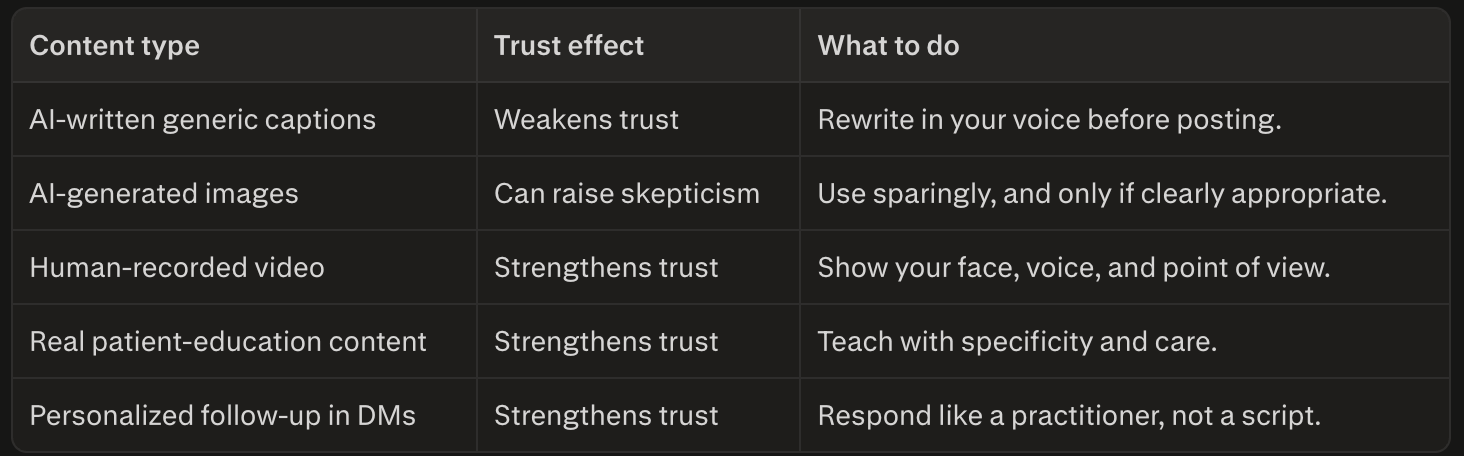
The practical change is simple: let AI save you time, not credibility.
5 — Reassurance with Honest Truth
If you have been using AI because you are tired, busy, or overwhelmed, I understand that. Most practitioners are trying to hold care, admin, marketing, and life at the same time. AI can feel like relief.
But relief is not the same as strategy.
Marketing is compounding, just like healing. If a patient quits after three sessions because they “don’t feel results yet,” we do not say the treatment failed. We say they did not stay long enough for it to work. The same is true here. Human trust takes time, and it grows through consistency, not polish.
The only way to guarantee you never see results is to quit before it compounds.
If you want specialized, ethical, long-term strategy support for your Instagram and overall digital presence, I work with health and wellness practitioners who are ready to build a system that actually brings in patients without burnout.
If you want to build a marketing strategy that uses AI to save time without sacrificing trust, I work with health and wellness practitioners to create ethical, sustainable marketing systems that attract the right patients while keeping your authentic voice at the centre of everything you do.