
By Josephine Ting | Josephine Ting Strategy & Management
There is a new front door to your practice that most practitioners do not even know exists.
It is not just Google. It is not just Instagram. It is the AI assistant in someone’s browser, on their phone, inside a search result, or in their earbuds.
A potential patient may now ask: “Who can help with chronic bloating in my area?” “What kind of practitioner supports nervous system dysregulation?” or “What should I look for in a functional nutritionist?” And increasingly, they may get a summarised answer before they ever see a list of websites.
Whether you show up in that answer depends on choices you make in your content right now.
The Reality: The Health Search Journey Has Changed
Let’s talk about this honestly. Most practitioners still think of discoverability as one thing: showing up on Google, posting on Instagram, or getting referred by another practitioner.
Those still matter. But the search journey is no longer that simple.
IQVIA Consumer Health’s 2026 analysis of AI and generative search explains that AI-driven search is compressing the consumer-health journey. Instead of researching across several websites, social platforms, and reviews, people can ask one detailed question and receive a personalised answer that pulls information together from across the web. IQVIA also notes that AI Overviews and large-language-model search are contributing to more zero-click journeys, where a person gets an answer without visiting a website at all.
Click Consult’s analysis of generative search in consumer health describes this as “total search”: discovery now happens across AI platforms, social channels, marketplaces, websites, and digital communities, rather than in one search engine alone.
For a practitioner, this changes the question.
It is no longer only: “Do I rank on Google?”
It is also: “When someone asks an AI tool about the problem I solve, is there enough clear, credible information about my practice for it to understand who I am?”
What the Data Actually Says
AI search does not work like a traditional search engine result page.
Traditional SEO focuses heavily on helping a page appear for a keyword. Generative search looks for information it can understand, compare, and safely summarise. That means it is evaluating the clarity of your content, your consistency across platforms, and the credibility signals surrounding your practice.
IQVIA’s 2025 guide to the shift from SEO to generative-engine optimisation explains that visibility now depends on both traditional search and AI-driven platforms such as ChatGPT, Copilot, and Gemini. It also identifies social media and video platforms, including Instagram, TikTok, and YouTube, as part of this wider search ecosystem.
This does not mean you need to be everywhere.
It means your digital presence needs to tell the same clear story everywhere you already are.
The strongest health-marketing guidance is increasingly consistent on this point. AI search is more likely to surface content that is:
- Clear and structured.
- Specific about who it is for.
- Directly responsive to real questions.
- Grounded in credible evidence and appropriately cautious health claims.
- Consistent with information found elsewhere online.
IQVIA’s 2026 AI and generative-search guidance puts it simply: AI-ready content uses clear structures, direct answers, and authoritative evidence that an AI system can safely cite or elevate.
For a practitioner, that means inspiration alone is not enough. A beautiful quote about healing may connect with existing followers, but it does not help a search system understand that you support women with IBS in Denver through functional nutrition.
You need content that makes your expertise legible.
Why Holistic Health Is Especially Affected
Holistic health practitioners are particularly vulnerable to the AI-search shift because your patients are often already confused, dismissed, or exhausted by impersonal systems.
They are not just looking for information. They are trying to decide who feels credible, safe, and able to understand the full picture.
Acute health practitioners
If you support people with pain, insomnia, digestion, hormonal symptoms, or fatigue, your potential patients often start with specific questions.
They might ask:
- “Why am I bloated every day?”
- “What type of practitioner helps with chronic fatigue?”
- “Functional medicine practitioner for hormonal symptoms near me.”
Your content needs to answer the educational part of those questions while being clear about the role you play. You are not trying to diagnose someone through a post. You are showing that you understand the symptom pattern, can explain your approach, and offer a clear next step.
For this group, AI-ready content includes:
- Symptom-focused FAQs.
- Service pages explaining your method.
- Clear location or telehealth information.
- Posts explaining what happens in a first appointment.
Long-term wellness practitioners
If you work in prevention, nervous system support, lifestyle change, or integrative wellbeing, your audience may ask broader questions.
They may be searching for:
- “How do I recover from burnout without pushing harder?”
- “What kind of support helps nervous system regulation?”
- “How do I build healthier habits when I am already overwhelmed?”
These people are rarely ready to book after one answer. They are evaluating whether you understand their lived reality.
For you, AI-ready content needs emotional clarity as well as practical clarity. Explain your approach in plain language. Share what sustainable support looks like. Make it clear who your work is and is not for.
Coaching practitioners
For coaches doing identity work, boundaries, confidence, behaviour change, or relationship support, the decision cycle can be longer.
Your ideal client might be quietly asking:
- “What is the difference between therapy and coaching?”
- “How do I find a coach for people-pleasing?”
- “What happens in a discovery call?”
If you have never answered these questions clearly on your website, in your content, or in your FAQs, an AI system has very little to work with.
Your job is not to write for robots. Your job is to answer the questions real people already ask before they feel ready to contact you.
That helps people. It also helps search.
What AI-Ready Content Actually Means
“AI-ready content” sounds technical, but it does not need to be.
It means creating content that is clear enough for a person to understand quickly and structured enough for a search system to interpret accurately.
Here is the difference:
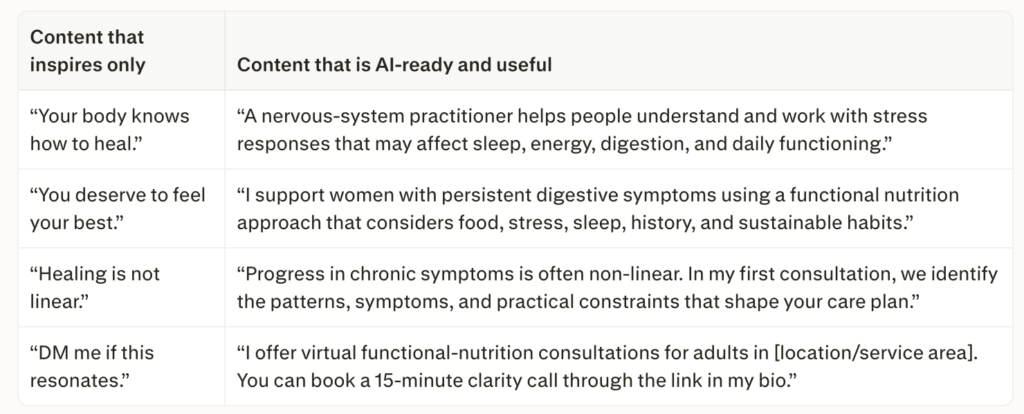
The first column may still have a place in your content. It can build connection. But it cannot carry your entire visibility strategy.
You need the second column too.
What to Do This Week
You do not need to rebuild your whole online presence overnight. Start with the information AI systems — and real patients — need most.
1. Write down the 10 questions patients ask before booking
Use:
- Questions you receive in DMs.
- Questions you answer on discovery calls.
- Questions patients ask in their first appointment.
- Questions they ask before they trust your approach.
Examples:
- “Can you help with [specific issue]?”
- “What does the first appointment involve?”
- “Do you work virtually or in person?”
- “What is the difference between your work and conventional care?”
- “How long does it usually take to see progress?”
- “Who is not a good fit for this service?”
Write one clear, compassionate answer to each. Then use those answers on your website, in blog posts, carousels, Reels, YouTube videos, and Stories.
2. Make your specialty and location unmissable
A potential patient and an AI system both need to understand three things quickly:
- What you do.
- Who you help.
- Where or how you work.
For example:
“I am a functional nutrition practitioner supporting women with digestive symptoms, fatigue, and food-related stress through virtual consultations across [region].”
That belongs:
- On your website homepage.
- On your services page.
- In your Instagram name field or bio.
- In your Google Business Profile.
- In your YouTube channel description, if you use YouTube.
Google’s Business Profile guidance specifically advises businesses to represent themselves consistently across their real-world and online presence, with accurate addresses or service areas and the fewest, most precise categories needed to describe the core business.
Consistency is not boring. It is a trust signal.
3. Treat your Google Business Profile as essential
If you have an in-person practice or serve a defined local area, your Google Business Profile is not optional.
Google says a verified Business Profile helps people discover a business through Search and Maps, with details such as hours, photos, updates, and responses to reviews all part of the experience.
Make sure yours includes:
- Your correct practice name.
- Current phone number, website, hours, and address or service area.
- The most accurate primary category.
- Your current services.
- Real photos of your practice, workspace, or professional self.
- A clear route to booking.
Do not add services you do not offer. Do not exaggerate outcomes. Health marketing has to remain accurate, ethical, and safe.
4. Build an FAQ into your core pages
Do not bury all your answers in Instagram captions.
Add three to five patient questions to each core service page. Use plain language, and answer the question directly in the first sentence.
For example:
What happens in a first functional nutrition appointment?
“In a first appointment, we review your symptoms, health history, current routines, and goals so we can identify practical next steps that fit your life.”
That is useful to a person. It is also the kind of clear answer AI systems can interpret and summarise.
5. Use YouTube and social content to reinforce your expertise
Instagram can still be a powerful trust-building channel. But it should not be your only source of information about your practice.
Use your social content to reinforce what you want to be known for:
- One symptom or concern.
- One patient group.
- One clear method or philosophy.
- One consistent next step.
Video is especially useful because it helps people see and hear you before they book. IQVIA’s guidance on expanded search specifically includes YouTube, social channels, and AI platforms as connected elements of discoverability now.
You do not need to post everywhere. Choose one social platform and one searchable longer-form channel you can sustain.
For many practitioners, that may look like:
- Instagram for trust and conversation.
- A website or blog for FAQs and service information.
- Google Business Profile for local discovery.
- YouTube for deeper explanations, if video is realistic for you.
Reassurance With Honest Truth
If this feels like another thing you are supposed to keep up with, I understand. The digital landscape changes quickly, and practitioners are already carrying patient care, admin, clinical responsibility, and the emotional weight of running a practice.
But this is not about chasing every new platform.
It is about making your existing expertise clear enough to be found.
Think of it like patient care. You would not hand someone a vague treatment plan and expect them to know what to do next. You explain what is happening, what you recommend, and how they can get support. AI-ready content is the same: clear information, consistent signals, and a safe next step.
You do not need to become an AI expert. You need to become easier to understand.
The only way to guarantee you never see results is to quit before it compounds.
Can AI Search Actually Understand Your Practice?
That is the question I want you to leave with.
Search is changing, but the fundamentals of good health and wellness marketing are not. You still need to be clear about who you help, what you help with, how your approach is different, and why a potential patient should trust you. The difference now is that this information needs to be understandable not only to the person visiting your website, but to the search systems helping them decide where to look in the first place.
You do not need to chase every AI platform or completely rebuild your marketing. You need a digital presence that communicates your expertise clearly and consistently across your website, search presence, social media, and the other places patients may encounter you.
If you’re not sure whether your current digital presence is doing that, book a free 15-minute marketing audit with me. I’ll take a look at how your practice is currently showing up online, where potential patients—or search platforms—may be losing the thread, and what I would prioritize next.
Because in 2026, being good at what you do is only part of the equation. The right patients also need to be able to find you, understand you, and trust you.