
By Josephine Ting | Josephine Ting Strategy & Management
Every marketing conversation eventually circles back to reach. How many followers. How many views. How many impressions.
But in the health and wellness industry, reach without trust is not just useless — it’s actively expensive. You can have 100,000 people see your post, but if none of them believe you can actually help them, you’ve spent time and energy for nothing.
Here’s what trust actually costs to build, and why it’s the only metric that converts a viewer into a patient.
1 — The Reality: Attention Is Everywhere. Trust Is Not.
Let’s talk about this honestly. The wellness market is bigger than ever, and it’s only getting more crowded. According to McKinsey’s 2025 Future of Wellness report, over 50% of global consumers now consider wellness a top priority, and 84% of U.S. consumers say wellness is a “top” or “important” life priority.
That means competition for attention in this space has never been higher. But attention is not the bottleneck anymore. Belief is.
The differentiator is not reach — it’s trust. And trust is harder to build than it used to be. The IDHL 2026 Health and Beauty Consumer Research found that 47% of consumers say proven results are the most important factor when choosing a health product or service, and 79% feel overwhelmed by choice overload in wellness.
Think about what that means for you as a practitioner. Almost half of your potential patients are actively looking for proof that you can help them. And 8 out of 10 feel like there are too many options. The practitioner who makes people feel safe and clearly explains their approach is the one who wins.
2 — What the Data Actually Says
Trust Velocity: The Metric That Actually Matters
In the 2026 Digital Marketing Playbook for Health & Wellness by Omar Romero, the concept of Trust Velocity is introduced as a real business metric: how quickly a new person believes your brand can improve their life.
This is not a vanity metric. It’s a conversion metric. Trust velocity is measured through:
- DM quality (how many people ask detailed questions)
- Saves and shares (how many people save your posts or share them with friends)
- Meaningful comments (not just “love this,” but “how do I start?”)
The playbook argues that in 2026, trust will be the most valuable currency in marketing, and the most effective operators will measure Trust Velocity instead of reach.
For you, this means: stop counting followers. Start counting how many people are engaging in ways that show they believe you can help them.
The Cost of Trust vs. The Cost of Reach
The same playbook notes that the algorithms are changing, consumer fatigue is rising, and attention spans are shorter than ever. Instead of chasing more reach, you need to measure:
- Conversion-to-Retention Ratio: It’s not about how many sign up — it’s how many stay.
- Community Engagement Depth: Track saves, shares, and meaningful comments (not likes).
- Cost of Trust: How much does it cost you to build belief in your brand?
This shift from “reach” to “resonance” is already shaping the future of marketing.
Practically: if you spend 2 hours creating a post that gets 10,000 views but 0 DMs, you’ve spent 2 hours for nothing. If you spend 1 hour creating a post that gets 1,000 views but 15 DMs and 50 saves, you’ve built trust.
The Compounding Nature of Trust
The Omar Romero piece also emphasizes that trust compounds. Every piece of content either deposits into or withdraws from the trust account, and what types of posts do which matters.
- Trust deposits: transparent stories, case studies (without violating compliance), clear explanations of your approach, behind-the-scenes content
- Trust withdrawals: overpromising, vague claims, inconsistent messaging, engagement bait
If a patient quits after three sessions because they “don’t feel results yet,” we don’t say the treatment failed. We say they didn’t stay long enough for it to work. Same logic applies here. Trust compounds over time. The only way to guarantee you never see results is to quit before it compounds.
3 — Industry-Specific Nuance: How Trust Looks Different
Acute Health Practitioners (Pain, Sleep, Digestion, Hormonal Issues)
For acute practitioners, trust is built through clarity and specificity. Your audience is in “fix it now” mode. They’re not looking for “general wellness.” They’re looking for relief from something specific.
Trust signals that work:
- “How I helped X with Y in Z weeks” (without violating compliance)
- “The difference between symptom management and root-cause work”
- “What to expect before your first visit” posts
Your Trust Velocity is measured by:
- DMs asking about specific protocols
- Saves on posts about your approach
- Shares to friends with similar issues
Long-Term Wellness Practitioners (Prevention, Nervous System, Lifestyle)
For long-term wellness practitioners, your audience is in “preparation mode.” They’re not desperate, but they are curious. They want to feel safe investing time and money into something that might take months or years.
Trust signals that work:
- “What no one tells you about lifestyle change”
- “The difference between X and Y” posts
- “How I support clients over 6–12 months” stories
Your Trust Velocity is measured by:
- DMs asking about long-term support
- Saves on posts about your philosophy
- Comments asking deeper questions
Coaching Practitioners (High Trust, Identity Work, Longer Decision Cycles)
Coaching practitioners often sell transformation over time. Your audience is dealing with identity, self-worth, relationships, and patterns that have been there for years.
Trust signals that work:
- “What I see in clients who wait 6 months vs. start now”
- “The difference between X and Y” identity posts
- “What to expect in your first 3 sessions” stories
Your Trust Velocity is measured by:
- DMs asking about coaching packages
- Saves on posts about your approach to identity work
- Shares to friends who “need to hear this”
4 — Strategic Implications: What to Actually Do Tomorrow
Here’s the part you can act on immediately.
Measure Trust, Not Reach
Starting this week, track these instead of follower count:
- DM quality: How many people ask detailed questions about your work?
- Saves: How many people save your posts? (This is a strong trust signal — they’re saying “I want to come back to this.”)
- Shares: How many people share your posts to their Stories or DMs?
- Meaningful comments: Not just “love this,” but “how do I start?” or “this resonates.”
If you’re getting 1,000 views but 0 DMs, 0 saves, and 0 meaningful comments, you’re not building trust. You’re just making noise.
Create Trust-Depositing Content
Every piece of content either deposits into or withdraws from the trust account. Make sure more of your content is depositing than withdrawing.
Trust deposits:
- Transparent stories about your own journey
- Clear explanations of your approach (no jargon)
- Case studies (without violating compliance)
- Behind-the-scenes content (how you work, what sessions look like)
Trust withdrawals:
- Overpromising (“I can fix your hormones in 2 weeks!”)
- Vague claims (“I help women feel their best”)
- Inconsistent messaging (posting about gut health one day, Manifestation the next)
- Engagement bait (“Comment ‘YES’ if you agree!”)
Use This Framework for Your Next 5 Posts
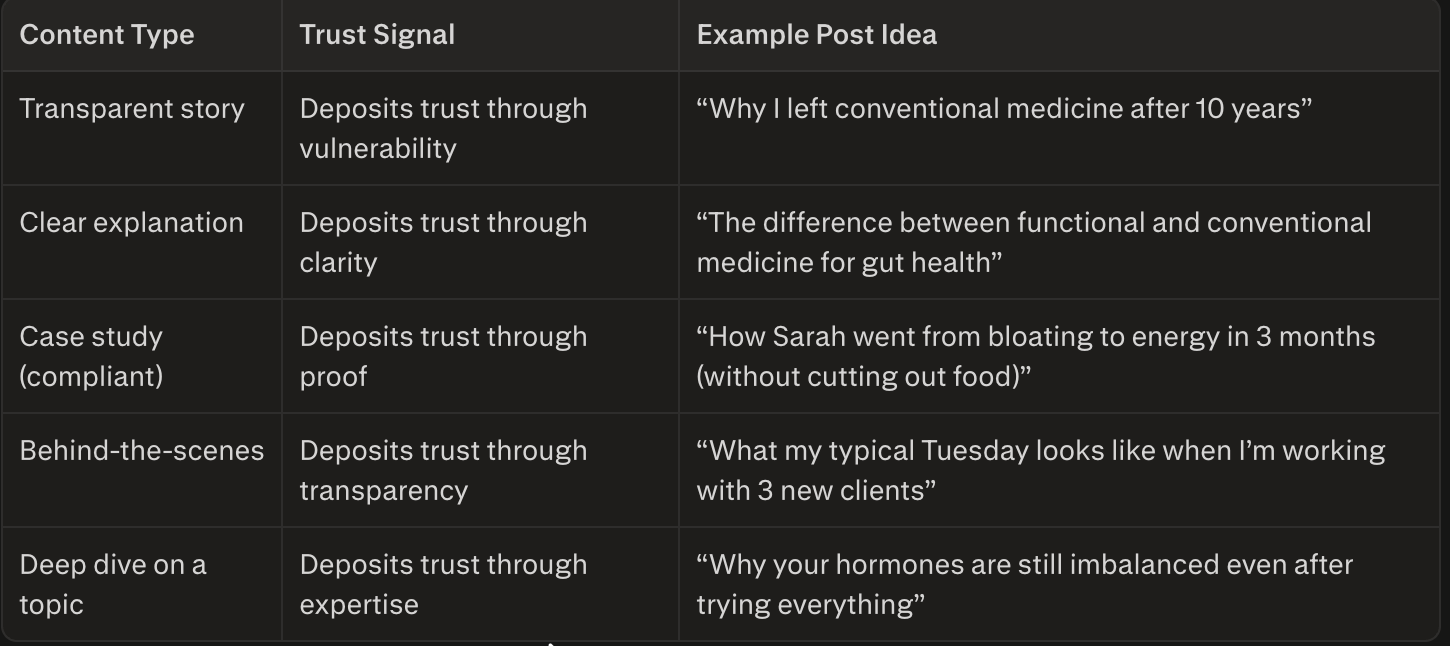
This is not about being “more motivational.” It’s about being more intentional.
Stop Chasing Reach. Start Chasing Resonance.
The Omar Romero piece argues that in 2026, community isn’t an afterthought — it’s your marketing strategy. Every DM, comment, and email is a touchpoint that reinforces belonging.
- Reply to comments with thoughtful answers, not just “Thanks.”
- Show up in Stories with behind-the-scenes, Q&As, and client wins.
- DM people who engage with your content with a simple, low-pressure message.
This is not about being “more active.” It’s about being more human.
5 — Reassurance with Honest Truth
If your reach has been low but your trust has been high, you’re not failing as a practitioner. You’re building something that actually lasts.
Marketing is compounding, just like healing. If a patient quits after three sessions because they “don’t feel results yet,” we don’t say the treatment failed. We say they didn’t stay long enough for it to work. Same logic applies here.
Trust compounds over time. The only way to guarantee you never see results is to quit before it compounds.