
By Josephine Ting | Josephine Ting Strategy & Management
The most common mistake I see in practitioner social media is measuring the wrong things.
Follower count and likes are easy to see. They’re also easy to get emotionally attached to. But they are the least useful signals when it comes to understanding whether your strategy is actually building something.
If you’re a health or wellness practitioner, you do not need a bigger number for the sake of a bigger number. You need to know whether your content is building trust, driving the right people to your profile, and creating actual inquiry.
That’s what we’re measuring here.
1 — The Reality: Vanity Metrics Feel Good, But They Don’t Tell You Much
Let’s talk about this honestly. Most social media dashboards reward what is visible, not what is valuable. Likes, impressions, and follower growth are easy to track, so they become the default. But in health and wellness, those numbers can be misleading.
According to Metricool’s 2026 Social Media Study, the dataset behind the report includes more than 39 million posts from over a million real accounts, which makes it one of the stronger public snapshots of what’s actually happening across platforms. Metricool’s separate 2026 Instagram study found that likes on posts are down 48%, while carousels get 9x more saves than single-image posts. That is not a small shift. It means people are interacting differently now, and the platforms are rewarding deeper engagement over passive approval.metricool+1
Here’s the part nobody told you: a like is a weak signal. A save is a stronger one. A share is stronger still. And a DM inquiry is stronger than all of them, because it means someone moved from consuming your content to considering you as a practitioner.
The same pattern shows up in Dash Social’s 2026 Health and Wellness Industry Benchmarks, which are based on a sample of global brands across TikTok, Instagram, and YouTube. Their wellness data shows that views are up, but engagement is not keeping pace in the same way. On TikTok, wellness views rose 146%, while engagement fell from 3.1% to 2.3%. More eyeballs do not automatically mean more trust.
That is the real issue. Reach gets attention. Trust gets action.
2 — What the Data Actually Says
The metrics that matter most
If you want to know whether your strategy is working, these are the metrics I want you watching:
- Saves: People are saying, “This is useful enough to come back to.”
- Shares: People are saying, “This is useful enough to send to someone else.”
- DM inquiries: People are moving from passive interest to direct contact.
- Profile visits from non-followers: New people are finding you and checking whether you’re relevant.
- Link clicks: People are taking a concrete next step.
- Comments with substance: Not “love this,” but actual questions or reflections.
Metricool’s 2026 study is especially useful here because it reflects a large-scale content reality: more content is being posted, but the strongest signal is no longer simple approval. It is deeper interaction.metricool+1
Why likes are losing meaning
Metricool’s 2026 Instagram research found that engagement is shifting toward formats that invite more intentional behavior, especially carousels, which earn far more saves than single-image posts. That matters because saves usually indicate that someone found the content practical, educational, or worth revisiting.
For a practitioner, that means a post with fewer likes but more saves is often the better post.
A post that gets 200 likes and no saves may have been pleasant.
A post that gets 40 likes, 25 saves, and 3 DMs may actually be working.
Why industry benchmarks matter
The Dash Social health and wellness benchmark report is important because it reminds you not to compare your practice to entertainment accounts, lifestyle creators, or beauty brands. Those accounts are playing a different game. Their content may be built to entertain, not to build clinical trust.
Dash Social’s wellness data shows:
- TikTok monthly follower growth averages 2.6% for wellness brands.
- Instagram wellness engagement averages around 1.0% to 2.0% according to their benchmarks.
- YouTube view averages for health and wellness brands sit around 46.5K.
That means if your metrics look “small” by comparison to a viral creator, that may be completely normal for your niche. The question is not whether your account is huge. The question is whether the people seeing it are moving closer to booking.
Trust is the real KPI
Omar Romero’s 2026 Digital Marketing Playbook for Health & Wellness argues that trust velocity matters more than reach in this industry — in other words, how quickly a new person believes you can help them.
That is the metric behind all the others.
If your content creates trust, your DMs improve.
If your DMs improve, your inquiries improve.
If your inquiries improve, your business becomes more stable.
3 — Industry-Specific Nuance: Different Practitioners Need Different Benchmarks
Acute health practitioners
If you work in pain, sleep, digestion, or hormonal issues, your audience is usually looking for relief now. They are often arriving after trying something else that didn’t work.
For you, the best metrics are not just likes or follower growth. It’s:
- Saves on educational posts.
- DMs asking about symptoms or intake.
- Profile visits from non-followers.
- Link clicks to consult or booking pages.
A low-like post can still be excellent if it helps the right person understand, “This is for me.”
Long-term wellness practitioners
If your work is prevention, nervous system regulation, or lifestyle change, your audience is often slower to convert. They are evaluating whether your approach feels sustainable and safe.
For you, I care more about:
- Consistent saves and shares.
- Comments that show resonance.
- Repeat profile visits.
- Link clicks to long-form resources, newsletters, or discovery calls.
You are not usually selling urgency. You are selling confidence over time.
Coaching practitioners
If you’re a coach, your work is often tied to identity, behavior change, and trust. That means the emotional quality of your engagement matters a lot.
For you, the strongest signs are:
- DMs that ask personal, reflective questions.
- Shares from people saying, “This is exactly what I needed.”
- Comments that show the content hit a nerve in the right way.
- Clicks to book a consult or read more about your process.
In your case, a post that starts a conversation is often more valuable than a post that simply performs well.
4 — Strategic Implications: What to Actually Do Tomorrow
Here’s the monthly audit I want you to run. It should take under 30 minutes.
The 30-minute monthly audit
1. Check your top 5 posts from the last month
Look at:
- Saves
- Shares
- Comments
- Profile visits
- Link clicks
Ask: which post brought the right kind of attention, not just the most attention?
2. Compare month over month
Ask:
- Are saves increasing?
- Are DMs improving in quality?
- Are more non-followers visiting your profile?
- Are clicks leading to actual action?
You are looking for movement, not perfection.
3. Identify the type of content that produced the best signals
Was it:
- Educational?
- Story-based?
- Behind-the-scenes?
- Case-study based?
- Founder-led video?
Then make more of that.
4. Look for the bottleneck
If your saves are high but DMs are low, your content may be useful but not persuasive enough.
If your DMs are high but bookings are low, your offer or booking flow may be unclear.
If your profile visits are high but follower growth is low, your profile may not be telling people why to stay.
What low metrics usually mean
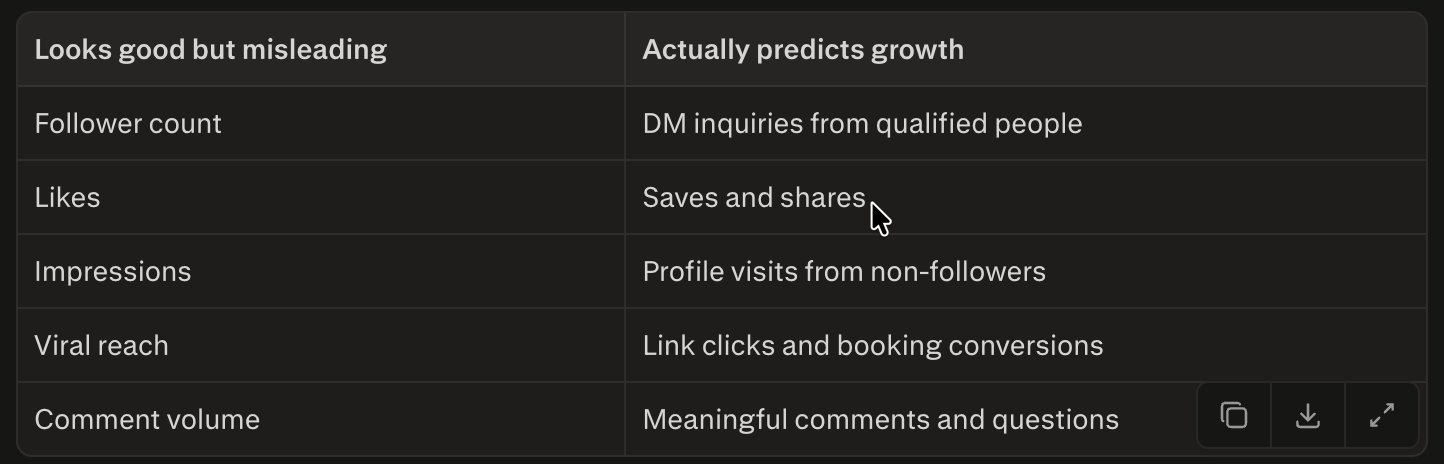
This is the real difference between noise and momentum.
Stop comparing yourself to the wrong accounts
Dash Social’s wellness benchmarks make this plain: health and wellness accounts do not perform the same way entertainment accounts do. If you compare your content to a creator with broad lifestyle appeal, you will almost always feel behind.
Don’t do that to yourself.
Compare your account to:
- Your own previous month.
- Your own lead quality.
- Your own booking flow.
- Your own content mix.
That is the level of comparison that will help you make better decisions.
5 — Reassurance with Honest Truth
If your follower count has been flat, that does not automatically mean your strategy is failing. Sometimes it means your content is doing its real job: attracting the right people instead of the most people.
Marketing is compounding, just like healing. If a patient quits after three sessions because they “don’t feel results yet,” we don’t say the treatment failed. We say they didn’t stay long enough for it to work. Same logic applies here.
The only way to guarantee you never see results is to quit before it compounds.
If you’re not sure whether your marketing is actually working, you’re not alone. Many health and wellness practitioners spend hours creating content without knowing which metrics truly indicate progress or where they’re losing potential patients.
During a Free 15-Minute Marketing Audit, we’ll review your current marketing strategy, analyse what’s working (and what isn’t), identify the metrics that actually matter for your practice, and highlight practical opportunities to attract more of the right patients.