

By Josephine Ting | Josephine Ting Strategy & Management
“Content pillars” is one of those marketing terms that gets thrown around without anyone explaining what it means for a real practitioner with a real practice.
You may have heard that you need them. Maybe you have even tried to make them before. But then you sit down to plan content and still end up staring at a blank calendar, posting whatever feels relevant that day, or wondering why people engage with one post and disappear after the next.
Let me break this down plainly.
Content pillars are not a complicated marketing system. They are the core topics you return to so your audience — and the algorithm — can understand what you do, who you help, and why they should trust you.
The Reality: Random Content Is Hard to Trust
A content pillar is simply a core topic area your account is known for.
For example, if you are a nutrition practitioner specialising in gut health, your pillars might include gut-health education, your approach to food and healing, client transformation stories, and everyday practical support. You can create hundreds of posts from those areas without becoming repetitive.
Without pillars, your content tends to become reactive:
- One post about cortisol.
- One post about your morning coffee.
- One quote about self-worth.
- One post promoting a programme.
- Then something trending because you feel you need to post.
None of these posts may be bad. But together, they do not give a potential patient a clear reason to remember you.
Here’s what’s actually happening under the surface: people do not decide to book based on one post. They look for patterns. They want to know whether you understand their problem, whether your approach makes sense, and whether you are someone they can trust with their health.
A content pillar gives them that pattern.
It also gives Instagram a clearer pattern. Instagram’s own explanation of ranking says its systems use a person’s previous activity — including what they have followed, liked, saved, shared, and otherwise engaged with — to predict what content they may care about next. Feed, Explore, Reels, and Search each have separate ranking systems, but all are designed to surface content relevant to a person’s established interests. Instagram’s ranking explanation makes this clear: consistency around a relevant topic helps the platform understand who may be interested in your content.
That does not mean you need to talk about one thing forever. It means your account needs a clear centre of gravity.
What the Data Actually Says
Instagram does not have one single algorithm. It uses different ranking systems for Feed, Stories, Reels, Explore, and Search. But its official guidance is consistent: what people have engaged with before helps Instagram predict what they may want to see next. On Explore, Instagram specifically looks at posts people have liked, saved, shared, and commented on in the past to find similar material they may care about.
For a practitioner, this has a practical implication: when you consistently create useful content around a defined set of topics, you make it easier for the right people to find more of your work.
The broader 2026 algorithm guidance also points in the same direction. CreatorFlow’s 2026 Instagram algorithm analysis identifies watch time, sends per reach, and likes per reach as major ranking signals, while noting that Reels and Explore are discovery surfaces designed to show people content related to interests they have already demonstrated.
The point is not to become obsessed with the algorithm. The point is to stop making your audience work so hard to understand you.
For healthcare and wellness accounts, depth matters even more than broad entertainment value. The Socialmon Healthcare and Wellness Instagram Strategy Guide for 2026 notes that health audiences often research quietly: they save posts, review FAQs, watch several Reels, and assess whether a practitioner feels credible and approachable before they ever send a DM or book.
That is why content pillars matter. They allow someone to land on your account and quickly see:
- What you are qualified to help with.
- How you think about their problem.
- What working with you might feel like.
- Whether people like them have experienced meaningful change.
That is authority. Not loudness. Not posting every day. Clarity over time.
The Four Pillars Every Practitioner Needs
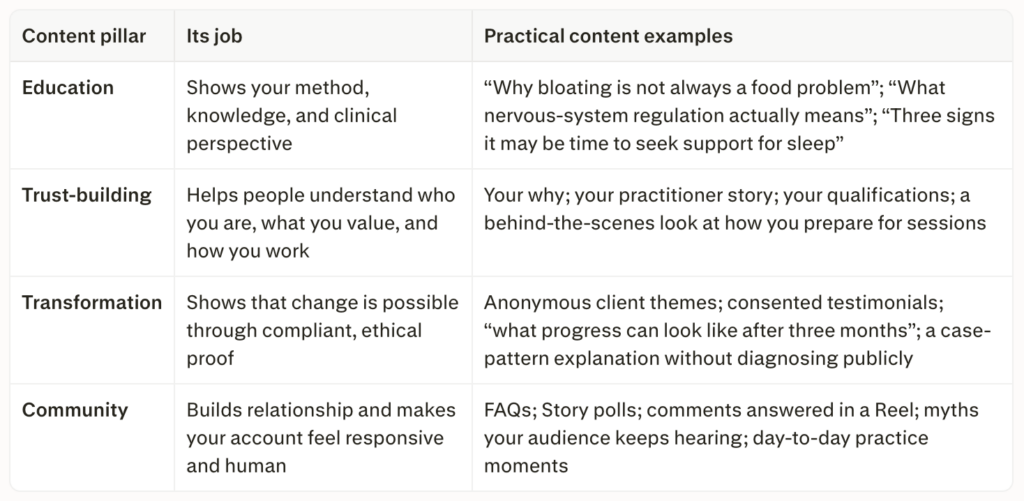
Most holistic health practitioners do well with four core pillars. Each has a different job in the patient journey.
Pillar 1: Education
Education is where you help people understand the problem you solve and the approach you take.
This is not about diagnosing strangers online. It is about explaining concepts in a way that helps someone feel less confused and more informed.
For example:
- A functional practitioner: “Why your fatigue may not be solved by simply taking another supplement.”
- A nutritionist: “What a balanced breakfast can look like when you are dealing with blood-sugar crashes.”
- A nervous-system practitioner: “Why ‘just relax’ is not useful advice when your body has been in survival mode for years.”
Your education pillar is how people answer: “Does this practitioner understand what I’m experiencing?”
Pillar 2: Trust-Building
Trust-building content answers a different question: “Can I trust this person with my care?”
This is where your humanity belongs. Your values. Your reason for choosing this work. Your boundaries. Your approach to patient safety.
You can share:
- Why you chose your speciality.
- What you wish more people understood before their first session.
- What your training taught you that social media gets wrong.
- A behind-the-scenes view of your process, workspace, or preparation.
Health audiences do not just evaluate credentials. They evaluate whether they will feel safe, respected, and listened to. Socialmon’s guide notes that patients often use Instagram to assess this before contacting a practice.
You do not need to overshare your personal life to build trust. You need to be recognisably human.
Pillar 3: Transformation
Transformation content shows what progress can look like.
For health practitioners, this needs care. It should never make unrealistic promises, expose patient information, or suggest that every person will get the same outcome. But ethical social proof is still important.
You can use:
- Anonymous, consented testimonials.
- Generalised patterns you see in practice.
- “What progress can look like” posts.
- A clear explanation of what changes clients often notice first.
- Process-focused stories: not “I fixed this person,” but “Here is how we supported this client through a gradual change.”
For example: “A client came to me exhausted by restrictive eating. We did not start with a meal plan. We started by stabilising meals, reducing fear around food, and building enough energy for the next step.”
That is more trustworthy than a dramatic claim. It shows your thinking, protects the patient, and respects the reality that healing is not linear.
Pillar 4: Community
Community content makes your practice feel accessible.
It can include:
- FAQs you receive repeatedly.
- Polls and question boxes in Stories.
- A response to a common misconception.
- A “what happens in a first appointment?” Reel.
- A simple check-in: “What is making your health feel harder this week?”
This pillar is not filler. It creates conversation, and conversation deepens trust.
Instagram’s ranking systems take account of relationship signals and interaction history. In practice, that means responses, comments, Story replies, and DMs help the platform understand that someone values an ongoing connection with your account.about.instagram+1
For a practitioner, that is useful because healthcare decisions are rarely made publicly. A person may never comment on a post about gut health, anxiety, pain, or burnout. But they may vote on a Story poll, save a carousel, or reply privately weeks later.
How This Changes by Practice Type
Content pillars are the structure. Your speciality determines what goes inside them.
Acute health practitioners
If you work with pain, sleep, digestion, fertility, hormonal concerns, or other urgent symptoms, your education content should be specific and practical.
Your audience is often actively searching for relief. They need clear explanations of:
- What may be happening.
- What your approach addresses.
- What a first appointment looks like.
- When it is appropriate to seek professional support.
Your transformation content should focus on realistic progress, process, and symptom impact — never guaranteed outcomes.
For example, a digestive-health practitioner might build pillars around:
- Gut symptoms and education.
- Root-cause, integrative assessment.
- What patients can expect during care.
- Anonymous stories of people moving from confusion to clarity.
Long-term wellness practitioners
If you work in prevention, nervous-system regulation, lifestyle support, or long-term wellbeing, your content needs more patience.
Your audience may not be ready to book today. They may have been carrying burnout, stress, or disconnection for years. Education needs to meet them where they are, not make them feel like another project to optimise.
Your pillars may include:
- Nervous-system or lifestyle education.
- Sustainable change over perfection.
- Your values and approach to care.
- Community conversations about what wellness realistically looks like.
You are not trying to create urgency where it does not belong. You are building familiarity and trust.
Coaching practitioners
Coaching often has the longest decision cycle because it involves identity, relationships, confidence, habits, or life direction.
Your transformation pillar matters deeply here, but it must be thoughtful. People want to know what change looks like without feeling sold a fantasy.
Your content can show:
- The difference between insight and sustained change.
- What a coaching relationship actually involves.
- The patterns you help clients work through.
- Your process, boundaries, and values.
The goal is not to convince someone in one post. It is to help the right person recognise themselves over time.
What to Do This Afternoon
You can build your first content-pillar plan in one afternoon. You do not need a complicated spreadsheet or 40 post ideas.
Step 1: Write down what you want to be known for
Complete this sentence:
“I want to be known for helping [specific people] with [specific problem or goal] through [your approach].”
For example:
“I want to be known for helping women with chronic digestive symptoms understand their bodies and build a sustainable, food-first plan.”
If you cannot write this sentence clearly, start there. Your pillars cannot be clear if your positioning is not clear.
Step 2: Choose your four pillar names
Use the framework above, then make the names relevant to your practice.
For example, a trauma-informed nutrition practitioner might use:
- Food and nervous-system education.
- A gentler approach to nutrition.
- Realistic client progress.
- Questions and everyday support.
A functional-medicine practitioner might use:
- Root-cause education.
- What care with me looks like.
- Patient outcomes and trust signals.
- FAQs and clinic life.
Step 3: List five post ideas under each pillar
You now have 20 content ideas. That is enough for roughly one month of content if you post four to five times per week.
Keep the ideas simple. Do not try to make every post a major production.
Step 4: Make your promotional content a supporting layer, not a pillar
You do need to sell. A practice cannot survive on education alone.
But a fifth “sales” pillar should usually make up no more than 20% of your content. If every fifth post is a clear invitation to book, that is plenty — especially if the other four pillars are doing their job.
The best promotional posts are connected to your other pillars:
- Education-led promotion: “If you recognise these patterns in your digestion, this is exactly what we explore in a first consultation.”
- Trust-led promotion: “Here is what I want you to know before deciding whether we are the right fit.”
- Transformation-led promotion: “Progress is possible, but it needs a plan that fits your actual life. Here is how I support that.”
- Community-led promotion: “I’ve received this question a lot this week. If you want individual support, my next appointments are available here.”
That is not manipulative. It is a clear next step for people who are already considering support.
Step 5: Review the mix before you post
At the end of the month, look at your content and ask:
- Did I teach people something useful?
- Did I show how I think and work?
- Did I make it easier for people to trust me?
- Did I invite people to work with me clearly?
- Does my account make sense to someone who has never met me?
If the answer is yes, your strategy is working at a structural level — even before the numbers compound.
Reassurance With Honest Truth
If you have been posting randomly because you are tired, busy, or carrying too much, I understand. Most practitioners did not get into this work because they wanted to become content planners.
But content pillars are not another demand on your time. They are what give you time back.
They reduce the weekly question of, “What am I supposed to post?” They help you repeat the messages that matter. They allow your audience to understand you before you need to explain your work from scratch in every DM.
Marketing is like patient care in this way: a scattered plan tends to create scattered results. If a patient changed their protocol every week, you would not expect to know what was working. Content is the same. You need enough consistency to see a pattern.
The only way to guarantee you never see results is to quit before it compounds.
Make Your Content Easier to Sustain
Your content should not feel like another full-time job on top of seeing patients and running your practice. A good strategy should actually make marketing simpler: you know what you want to be known for, you know which conversations you need to keep having, and you are not reinventing your content every Monday morning.
If you have gone through the exercise above and still feel unsure about your pillars—or you know the bigger issue is connecting your content to an actual patient-acquisition strategy—that is something we can look at together.
During a free 15-minute marketing audit, I can take a look at your current digital presence, identify where your messaging or content strategy may be losing people, and tell you what I would prioritize next.